
Month: January 2026
New Courtyard by Marriott Strengthens Quito’s Hotel Offerings
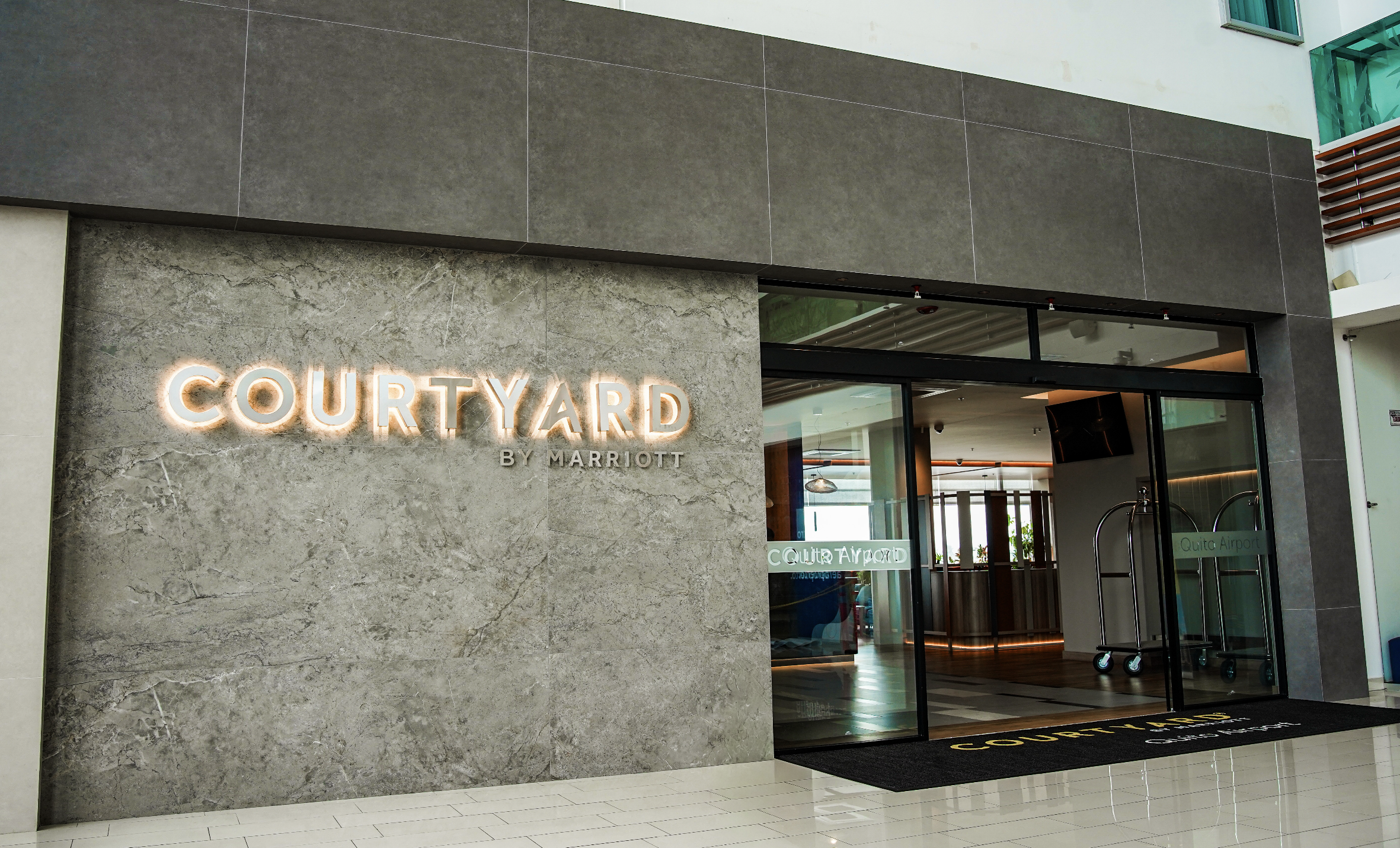
During its first month of operation, the hotel reached an occupancy rate of 40%, and a 55% occupancy rate is projected for the first half of the year. These figures demonstrate the positive reception of the project, its impact on the market, and the dynamism of the hotel sector nationwide.
The Courtyard by Marriott, part of the Sixstar Group, opened its doors to the public in January 2026 with an approximate investment of USD 7 million and the creation of 55 direct jobs during its first year of operation. The hotel boasts a strategic location, just steps from the Mariscal Sucre International Airport terminal.

This opening marks the arrival of the first Courtyard by Marriott in Quito and represents a new milestone for the SIXSTAR Hotels Group. With this addition, the group now operates a total of nine hotels in Quito, Guayaquil, Cuenca, and the Galápagos Islands, solidifying its position as one of the fastest-growing and most diversified hospitality groups in the country.
This project, developed in partnership with Corporación Quiport, the concessionaire in charge of the comprehensive management of Quito Airport, is an initiative aimed at improving the overall travel experience. The hotel incorporates the latest standards of the Courtyard by Marriott brand, globally recognized for its contemporary design and practical approach.
Courtyard by Marriott Quito Airport features 84 rooms, flexible spaces for working or relaxing, coworking areas, a gym, a restaurant, and a bar, all designed to meet the needs of the modern traveler who prioritizes efficiency, comfort, and connectivity.
Florencia Burneo, General Manager, states that “this new hotel was created for those seeking an efficient, comfortable, and hassle-free travel experience. Our location within the airport allows us to offer a truly convenient option that aligns with the essence of Courtyard.”
For his part, Ramón Miró, President and CEO of Corporación Quiport, thanked the SIXSTAR Hotels Group for their confidence in Quito Airport. “We are
proud of the arrival of such a prestigious chain as Courtyard by Marriott at Mariscal Sucre Airport, which allows us to offer more service options to our passengers and tourists arriving in the city, with a hotel located just steps from the terminal.”
It is important to mention that the hotel is part of Marriott Bonvoy, an award-winning travel program from Marriott International, which allows its members to earn and redeem points for stays, exclusive experiences, and benefits within a portfolio of more than 30 brands worldwide.
This project has the backing and operational experience of Grupo SIXSTAR Hotels, an Ecuadorian hotel operator that combines international standards with highly specialized local execution. For its first month of operation, the hotel projects an occupancy rate of approximately 40%, as part of an orderly and responsible opening process, accompanied by a competitive and market-leading airport rate.
Looking ahead to 2026, Grupo SIXSTAR Hotels continues to consolidate its expansion under a vision of planned and sustainable growth. Starting in March, the group will add the Hotel El Dorado in Cuenca to its portfolio, adding 52 rooms and strengthening its presence in a destination with high development potential. Currently, SIXSTAR Hotels Group generates approximately 850 direct jobs, contributing to the country’s economic and social development through the creation of formal, sustainable employment and the continuous strengthening of human talent.
Air Canada Resumes Operations in Quito
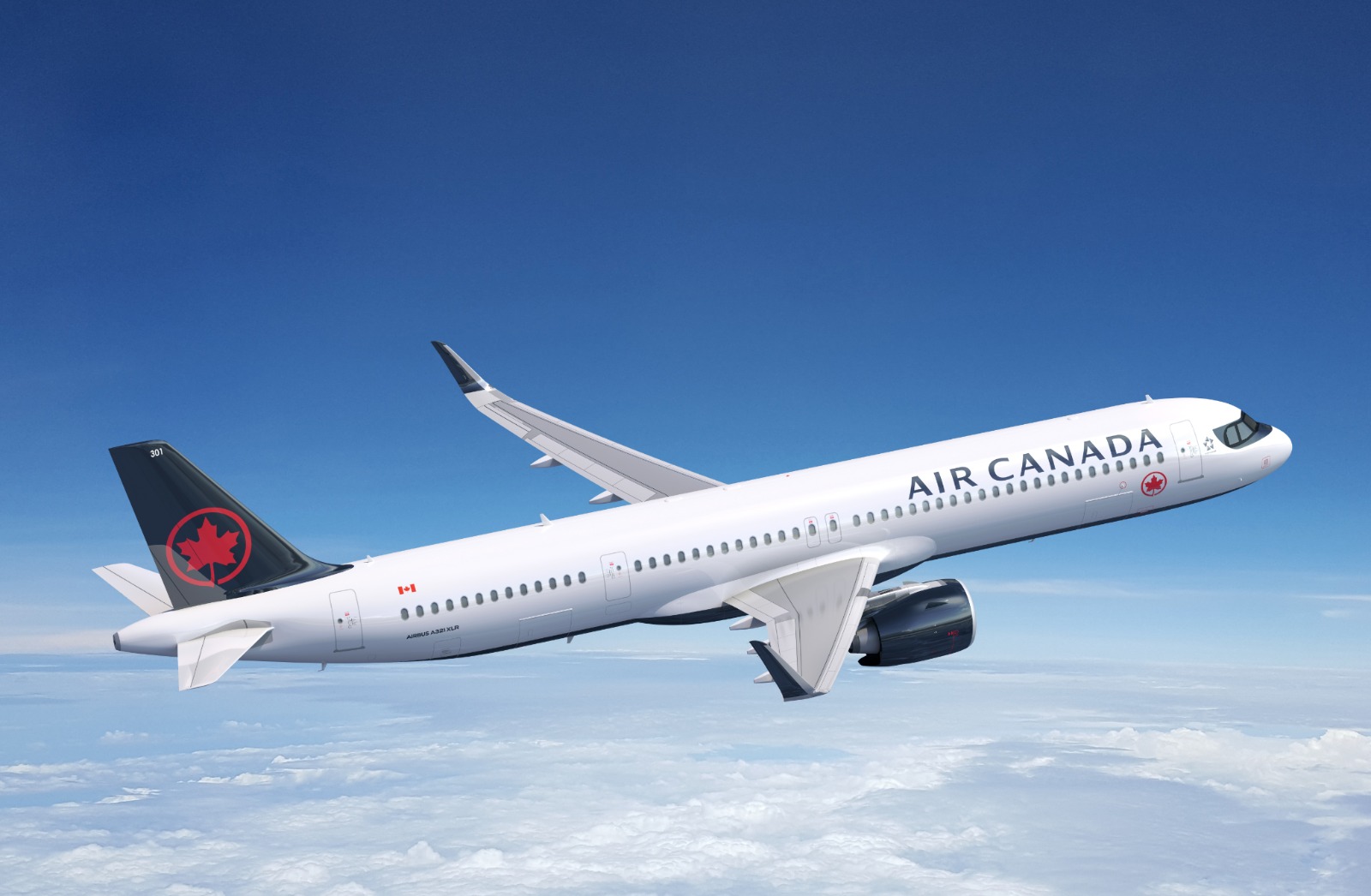
Starting December 4, 2026, the Canadian airline will return to Ecuador, connecting Quito with destinations in Canada with four weekly flights until the end of March 2027.
- The new Montreal-Quito route and the return of the Toronto-Quito route will expand the nonstop connectivity network at Mariscal Sucre Airport.
In a press release issued this morning, Air Canada, Canada’s leading airline, announced the resumption of its nonstop flights to Quito, starting in December of this year. The operation includes three weekly flights between Montreal and Quito, and one weekly flight between Toronto and Quito.
Air Canada’s return to Quito is the result of a significant effort by Corporación Quiport, which has been negotiating with the airline for the past several years. Air Canada will begin flights on December 4th of this year, and the seasonal operation will run until the end of March 2027.
Air Canada will operate these flights with Boeing 787 Dreamliner aircraft, with a capacity of 255 passengers, according to the following schedule:
- Montreal – Quito, arriving Thursdays, Saturdays, and Mondays at 12:10 a.m., and the return Quito – Montreal is scheduled for Thursdays, Saturdays, and Mondays at 9:00 a.m.
- Toronto – Quito, arriving Sundays at 12:10 a.m., and the return Quito – Toronto is scheduled for Sundays at 9:00 a.m.
Increased connectivity opens doors not only to greater tourism but also serves as a bridge to unite peoples and cultures, bringing the Ecuadorian community residing in Canada closer to their country of origin.
“With a comprehensive global network, the expansion of Air Canada’s winter schedule further strengthens our hubs as world-class global gateways, facilitating fast and convenient travel. Quito represents a strategic and exciting addition to our network, which will contribute to strengthening tourism, trade, and connectivity. Furthermore, our flights to Quito from our hubs in Toronto and Montreal will offer our customers and Aeroplan members more attractive opportunities to travel to Ecuador from virtually anywhere in the world, to, from, or through Canada,” said Mark Galardo, Executive Vice President, Chief Commercial Officer, and President of Cargo at Air Canada.
For Ramón Miró, president and CEO of Corporación Quiport, responsible for the comprehensive management of Quito International Airport, “Air Canada’s decision to resume operations between Canada and Quito with two main destinations like Toronto and Montreal is very important because we are recovering a market with great potential for tourism and business. With these routes, we are increasing the network of nonstop destinations from Quito, reinforcing our position as the main gateway to Ecuador and as the best-connected city in the country.”
Mariscal Sucre Airport Receives International Accreditation for Accessibility for People with Disabilities
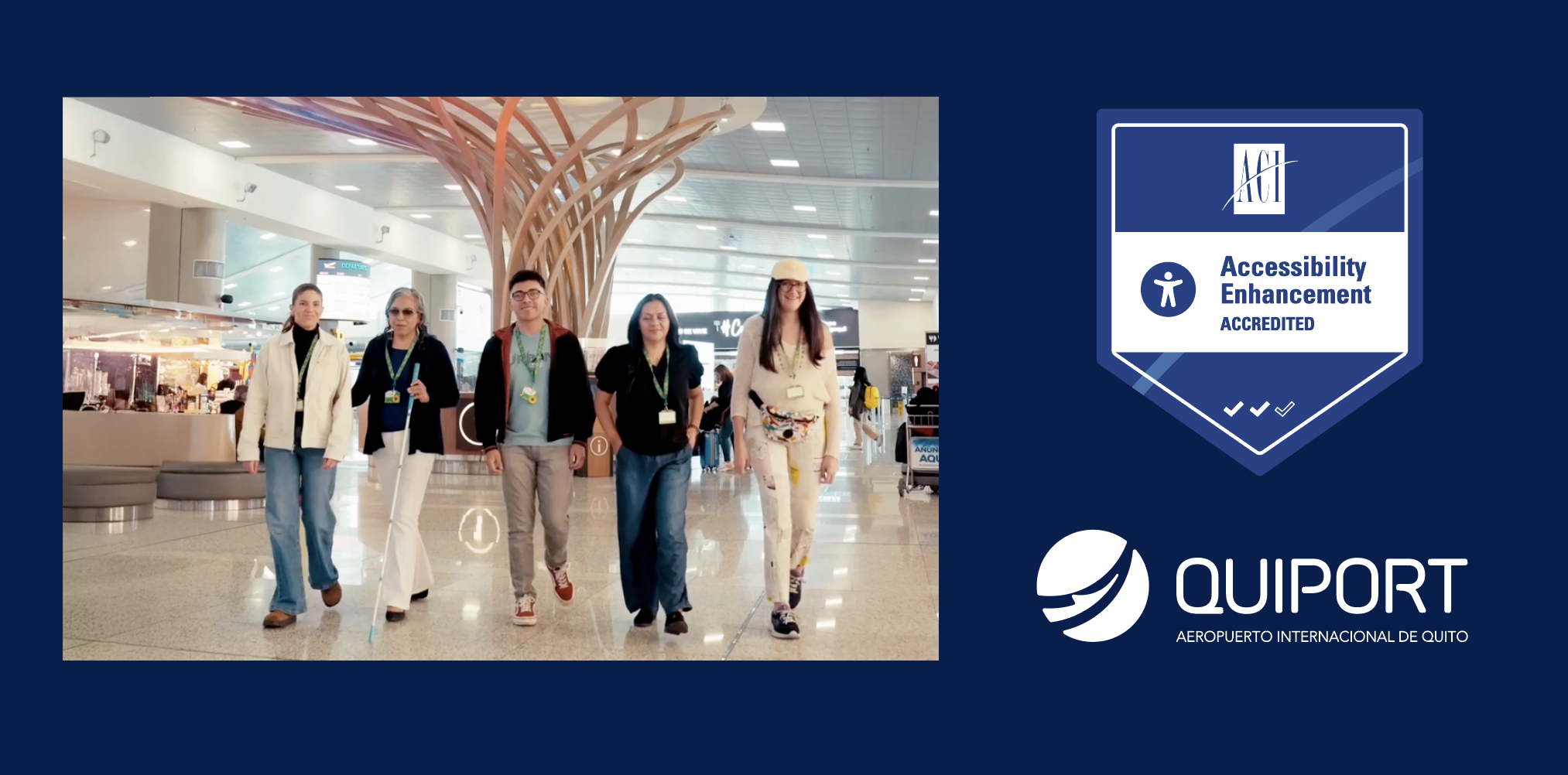
First airport in Ecuador and one of only four in Latin America and the Caribbean to obtain this international certification.
Quiport leads a sustained process of improvements focused on accessibility and the passenger experience for people with disabilities.
Quito’s Mariscal Sucre International Airport received Level 2 Accessibility Accreditation from the Airports Council International (ACI), becoming the first airport in Ecuador to achieve this level and one of only four airports in Latin America and the Caribbean with this distinction.
ACI’s Level 2 Accessibility Accreditation recognizes airports that have moved from diagnosis to action by having a formal accessibility plan, a governance framework, ongoing staff training, and the application of universal design principles and digital accessibility, with the goal of concretely improving the experience of passengers with disabilities throughout their entire journey at the airport.
This recognition is the result of a progressive improvement process. In 2024, the airport achieved Level 1, focused on mapping and identifying gaps. The advancement to Level 2, reached in 2026, reflects the implementation of real and measurable actions aimed at optimizing the passenger experience from a holistic perspective.
Within this framework, Mariscal Sucre Airport, managed and operated by Corporación Quiport, includes accessibility as part of its passenger experience strategy. In August 2026, the airport implemented the Hidden Disabilities Sunflower program, trained nearly 800 employees from companies and institutions within the airport community who work directly with passengers, strengthened its operational guidelines for inclusive service, and applied accessibility criteria in the expansion of the passenger terminal. This work is complemented by direct surveys of people with disabilities and the development of digital solutions that will continue to be implemented in 2026.
Another relevant action that ACI considered for the Level 2 rating is that the Quito airport website has incorporated international accessibility standards, including a digital accessibility policy and information on the airport’s facilities for people with disabilities.
“Achieving Level 2 is the result of sustained work that Quiport has been promoting together with the entire airport community, understanding that accessibility is not a one-off project, but rather a way of conceiving airport services based on the needs of all our users. This progress reflects a shared commitment to training, adapting, and continuously improving the passenger experience, incorporating accessibility as an essential component of daily operations,” said Ramón Miró, President and CEO of Quiport.
This recognition reaffirms the airport’s commitment to a more inclusive operation, aligned with international standards and the real needs of its users.

Circular Economy and Education: Quiport’s Contribution to the Construction of an Eco-Classroom in Tababela
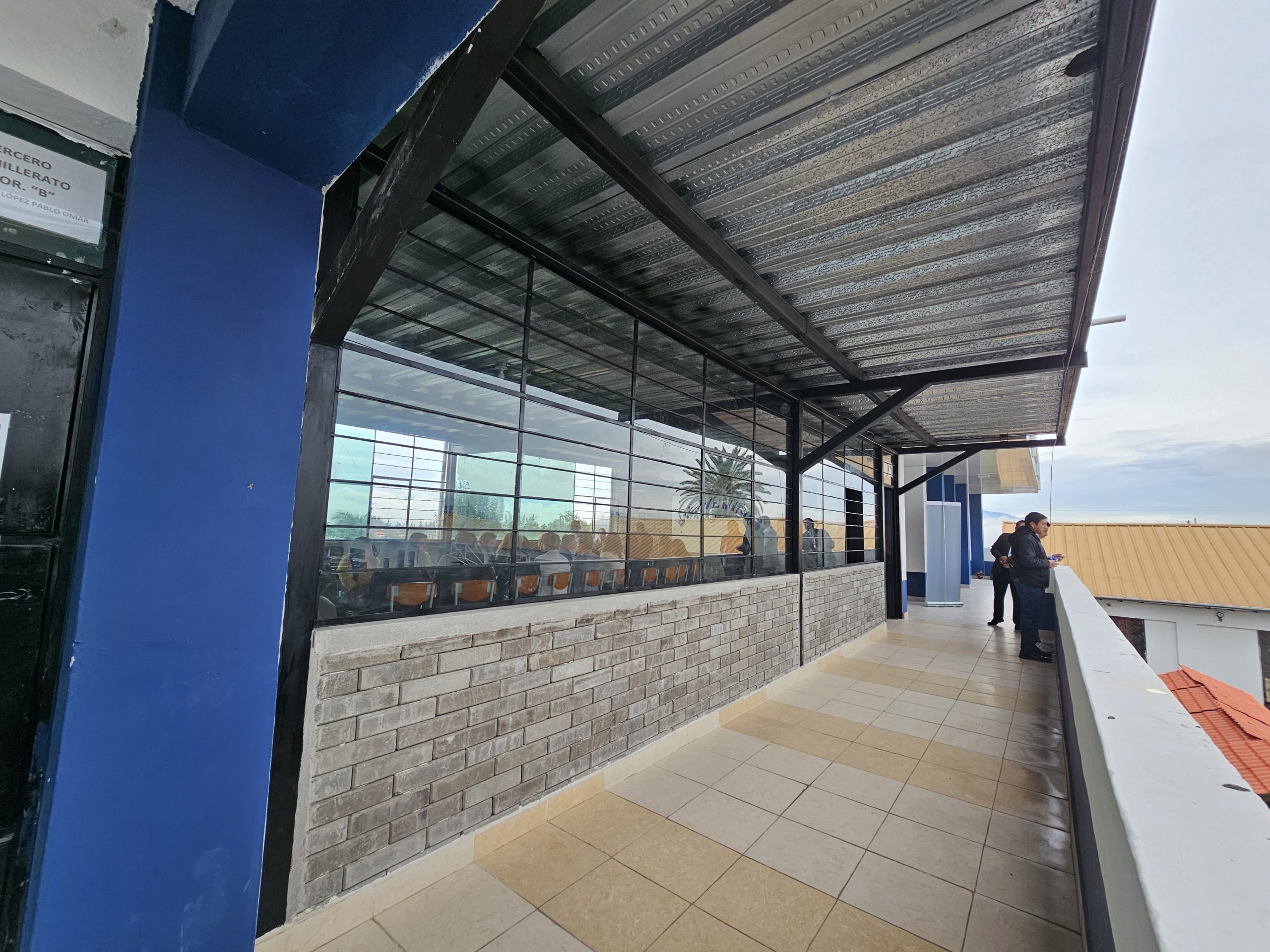
- Quiport’s eco-classroom model, based on the reuse of airport materials and guided by circular economy principles.
- This is the third eco-classroom developed in surrounding communities, in collaboration with educational institutions and local stakeholders.
The circular economy can become a concrete solution when it connects with the real needs of communities. With this vision, Quiport promotes the concept of eco-classrooms as educational spaces built from reused airport materials, a proposal that has been embraced by educational institutions in its area of influence as a sustainable alternative to strengthen their infrastructure.
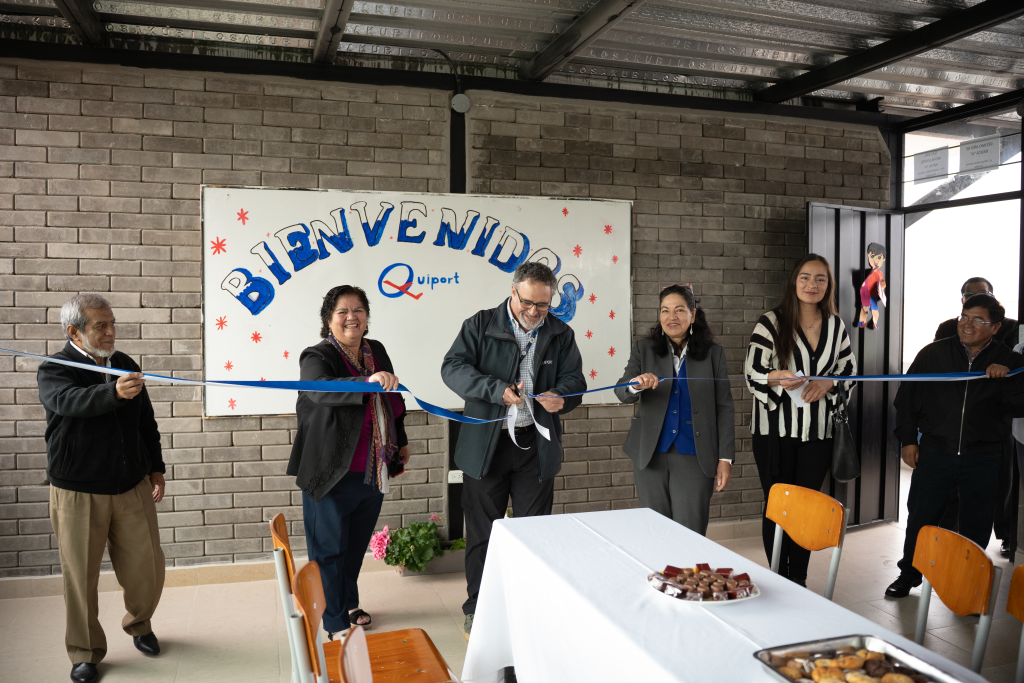
Within this framework, Quiport contributed materials and supported the construction process of a new eco-classroom in Tababela, as part of a model that has been gaining traction in communities near the airport.
This third eco-classroom, with an area of 120 m², was developed at the Dr. Arturo Freire School, an institution that adopted this model in response to its educational infrastructure needs, in line with Quiport’s commitment to sustainability, education, and strengthening the community.
A concrete contribution from the circular economy
As part of this support, Quiport donated reused materials in good condition, sourced from various stages of the airport’s operation and modernization, which were incorporated into the construction of the eco-classroom:
2,200 eco-blocks, made from the ash generated by the airport’s incinerator and processed by a certified environmental manager.
Large panes of glass, recovered from the passenger terminal expansion, in optimal condition for reuse.
120 meters of porcelain tile, obtained from the terminal’s floor renovation, carefully removed for reuse. These materials, which in other contexts might have been considered waste, were transformed into a concrete educational solution, demonstrating the potential of the circular economy applied to community infrastructure.
Collaborative work with community impact
The construction of the eco-classroom was made possible through the coordinated efforts of various stakeholders. Quiport volunteers contributed primarily to project planning, the development of the eco-classroom concept, and the coordination of material collection at the airport, while teachers, students, and parents actively participated in implementing the space at the educational institution.
In total, the project represented approximately 1,200 person-hours, reflecting a high level of collective commitment and shared responsibility among the stakeholders involved.
It is estimated that this eco-classroom will benefit more than 1,000 students and members of the educational community, improving the physical conditions for the teaching and learning process and promoting values related to environmental stewardship and the responsible use of resources.
Compartamos Program: Materials Transformed into Solutions
This project is part of the Compartamos Program, through which Quiport has channeled reusable materials to community initiatives with specific objectives for several years. The Tababela eco-classroom is the third project developed under this approach, following those implemented at the San Ignacio de Loyola and 3 de Diciembre de Checa schools, both located in communities near the airport.
A Vision of Sustainability with a Territorial Focus
“Promoting the circular economy implies assuming shared responsibility. Through this contribution, we support the educational community in building a solution that integrates environmental stewardship, resource reuse, and social development, and that also allows us to demonstrate to future generations that recycling and the responsible use of resources can become real spaces for learning and growth,” said Ramón Miró, President and CEO of Quiport.
Quito Airport Inaugurates New SULA Store
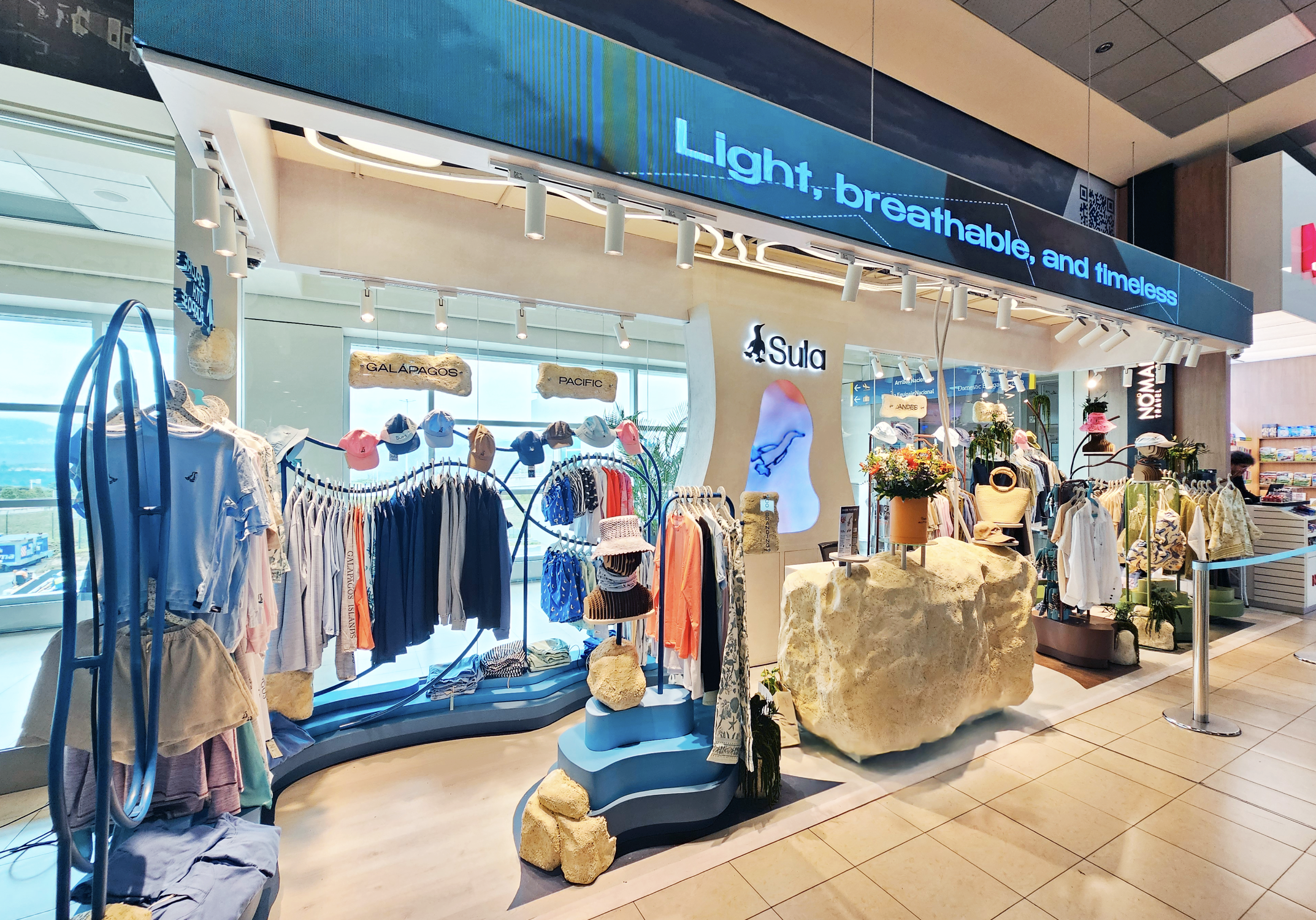
Quito’s Mariscal Sucre International Airport expands its retail offerings with the opening of the first store in the country for the Ecuadorian sustainable fashion brand SULA. Located in the domestic departures area, near pre-boarding hall A3, this new space provides passengers with a selection that combines design, local identity, and environmental commitment, just before they begin their journey.
SULA was founded in 2022 by Ecuadorian artisans and operates under a responsible production model: all its garments are 100% made in Ecuador, using certified sustainable fabrics such as recycled polyester (GRS), organic cotton (GOTS), and linen, as well as responsible dyeing processes that recycle the water used. The garments are made in collaboration with women artisans who are heads of household, solidifying fashion as a tool for positive social impact.
Inspired by the Andes, the Amazon, the Pacific, and the Galápagos Islands, the brand takes its name from the blue-footed booby (Sula nebouxii), a symbol of its commitment to biodiversity. Furthermore, SULA is a carbon-neutral fashion brand, a pioneer in Ecuador in obtaining this certification by measuring, reducing, and offsetting its emissions through eco-friendly processes.
“It is a pleasure to add to our commercial offerings a brand created by Ecuadorian hands, representing sustainable fashion and local talent. With this first SULA store in the country, we continue to strengthen the passenger experience within the airport, integrating identity, sustainability, and purposeful offerings,” stated Ramón Miró, President and CEO of Corporación Quiport.
Valentine’s Day Season 2026 Begins January 20 at Quito Airport
- According to industry forecasts, a 6% increase is expected compared to 2025.
- Ecuadorian flowers reach the world primarily through cargo hubs in the United States and Europe.
- Quito Airport ranks fifth among airports with the highest cargo volume in Latin America and the Caribbean.
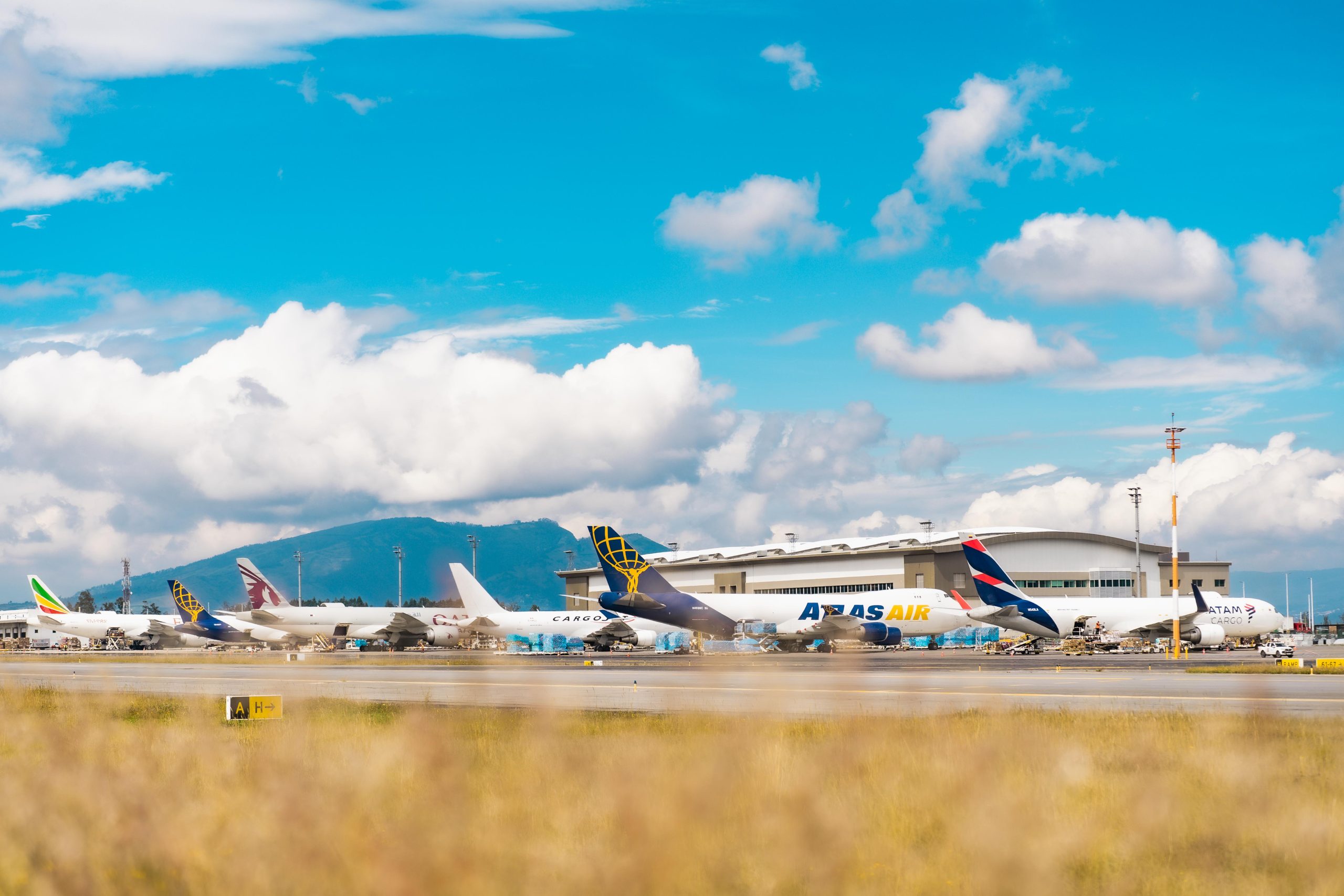
Tomorrow, Tuesday, January 20, the Valentine’s Day flower export season begins at Mariscal Sucre International Airport and will run until February 10. This year, a 6% increase in flower exports is expected, according to initial industry estimates.
In the 2025 season, the most successful on record, Ecuador exported a total of 28,779 metric tons of flowers—nearly 29 million kilograms—from Quito’s Mariscal Sucre Airport, shipped on 534 outbound flights. An increase in the number of flights is also expected this year.
The main destinations for Ecuadorian flowers are the major cargo distribution hubs in the United States and Europe, particularly Miami and Amsterdam, from where they are distributed to markets worldwide.
Cargo operations at Quito’s airport have experienced sustained growth, allowing it to rank fifth in Latin America and the Caribbean in terms of annual cargo volume. The year 2025 ended with a total of 407,240 tons of cargo transported across exports, imports, and domestic shipments. If we analyze only the performance of air cargo exports, 336,480 tons were exported from Quito, registering an 11.2% increase compared to 2014.
For Ramón Miró, president and CEO of Corporación Quiport, this is good news. “Air cargo performance is undoubtedly one of the main indicators we use to evaluate airport operations, as it allows us to measure the contribution of Quito’s airport to an activity that is key to the economic development of the city and the country.”
This is how 2025 unfolded for Quito’s airport: expansion, regional leadership, operational efficiency, and recognition
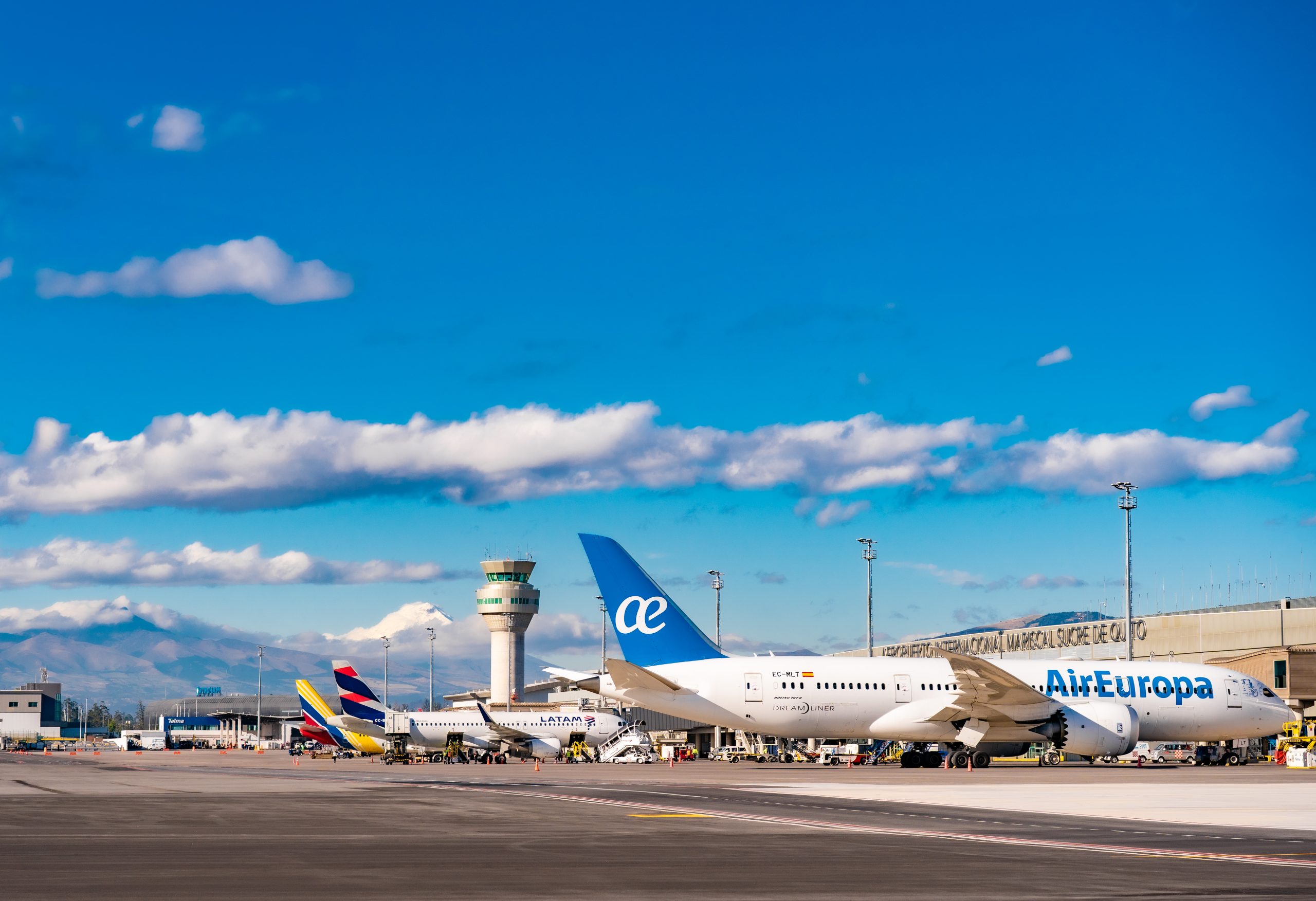
The year 2025 marked a turning point for Mariscal Sucre International Airport. Under the management of Corporación Quiport, the airport consolidated a key expansion and strengthened its operational, logistical, and connectivity performance.
Expansion and Capacity
With an investment of US$74.2 million, financed with Quiport’s own resources, the airport expansion became operational. The project, carried out by Ecuadorian workers, adds 17,647 m² to the passenger terminal and 35,000 m² to the apron, and incorporates larger areas for both international arrivals and departures, improvements to the baggage handling system, a reconfigured Customs area, new commercial spaces, 20 new airline check-in counters, and 12 self-service check-in kiosks. A pre-boarding lounge for 350 passengers; and the expansion of the international VIP lounge, which will be completed in 2026. These improvements increase the airport’s capacity from 5 to 7 million passengers annually.
Operational Efficiency
The implementation of new biometric gates in international departures streamlined immigration controls and enhanced the passenger experience, aligning operations with international standards. In the first phase of operation, the biometric gates can be used by Ecuadorian passengers over 18 years of age traveling to South American countries that do not require a visa.
Air Connectivity
During 2025, Quito Airport handled 5.4 million passengers, with 12 commercial airlines operating flights connecting the capital to 8 domestic and 14 international destinations. This performance solidifies the airport’s position as a strategic connection point for the country and the region. In this context, they highlighted the launch of direct Quito-Madrid flights by Air Europa and the announcement of the resumption of the Quito-Mexico City route by Aeroméxico—which will begin operations in March 2026—expanding connection options with Europe and North America. Additionally, there were increased frequencies to New York, Panama City, Bogotá, Lima, and Houston, increasing the number of seats available to these destinations.
The first four months of 2025 were marked by the uncertainty inherent in an electoral process, which influenced a reduction in passengers. However, starting in May, Quito’s airport registered a sustained increase in the number of travelers, allowing for a positive year-end, with a slight increase compared to 2024, a year in which 5.3 million passengers traveled.
Air Cargo
The logistics operation reaffirmed its regional leadership and maintained the growth trend recorded since 2021; Cargo volume grew from 364,000 metric tons in 2024* to 407,000 metric tons in 2025**, transported by 16 operating cargo airlines, consolidating Quito as a key driver of foreign trade, especially in flower exports, which account for 93% of the cargo exported from Quito Airport.
Experience and Recognition
Below are some of the key recognitions awarded by international organizations and specialized authorities, reflecting the operational performance, service quality, and environmental management of Mariscal Sucre International Airport during 2025.
- Quito Airport among the most punctual in the world, according to Cirium.
- Best Airport in Latin America and the Caribbean, in the Airport Service Quality (ASQ) program of the Airports Council International.
- Best Regional Airport in South America, in the Skytrax World Airport Awards.
- Fifth place in air cargo in Latin America and the Caribbean, according to ACI-LAC.
- Level 5 Passenger Experience Accreditation, renewed by the Airports Council International (ACI).
- “Blue Point” recognition, awarded by the Ministry of the Environment, for water management at Quito Airport.
- Award for coexistence between biodiversity and air operations, granted by ACI-LAC.
In summary, 2025 consolidated a larger, more modern, and more efficient airport, prepared to support the future growth of air transport, strengthen Ecuador’s logistics and connectivity, and enhance its contribution to tourism and the country’s economic development.
- Data corrected after receiving official figures from the General Directorate of Civil Aviation. The preliminary figure published on January 2, 2025, was 354,000 tons.
** Preliminary figures.