
Quiport Presents its 2025 Sustainability Report: When Operating Well Also Means Caring for Life
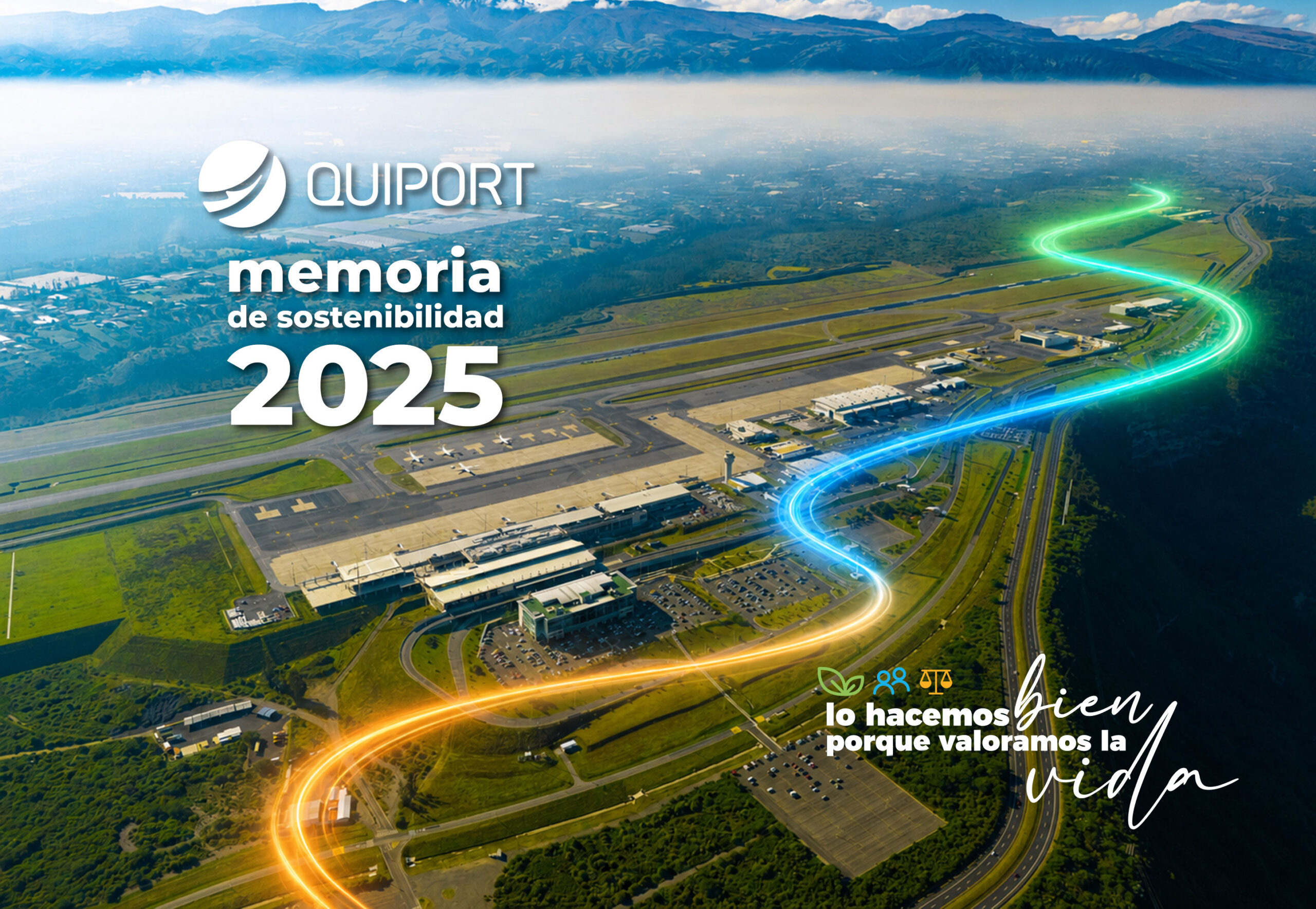
At Mariscal Sucre Airport, sustainability is built long before a plane takes off.
It begins with infrastructure planning, continues with safe and efficient operations, and is reflected in the responsible use of resources, the passenger experience, the well-being of employees, the commitment to neighboring communities, and respect for the environment surrounding the airport.
With this vision, Corporación Quiport presents its 2025 Sustainability Report, a document that compiles the main environmental, social, and governance achievements in the management of Mariscal Sucre International Airport.
“At Quiport, we understand that sustainability is not an additional chapter in our management, but rather the way we conceive and develop every activity,” says Ramón Miró, President and CEO of Quiport.
The report shows how that vision translates into concrete decisions, processes, infrastructure, and results.
Growing Responsibly
During 2025, Mariscal Sucre International Airport handled nearly 5.4 million passengers and 402,832 metric tons of cargo, solidifying its role as a key platform for connectivity, tourism, foreign trade, and Ecuador’s development.
One of the year’s most important milestones was the completion of the Quito airport expansion, a project that added 17,647 m² to the passenger terminal and 35,000 m² to the apron, with an investment of US$74.2 million, financed with Quiport’s own resources.
This expansion increased the airport’s processing capacity from 5 to more than 7 million passengers annually.
But growth also means doing so responsibly. The new infrastructure obtained EDGE Advanced international certification, becoming the first airport project in Ecuador to achieve this sustainable construction standard.
An operation that makes better use of its resources
Environmental management is one of the central pillars of the report. By 2025, 100% of the usable organic material received from the airport’s main commercial operators was transformed into compost, biofertilizer, biogas, or other alternative uses.
In addition, Quiport strengthened its recycling, co-processing, and reuse processes as part of a circular economy strategy that seeks to reduce landfill disposal and give new value to resources that can still be used.
Water management also reflects significant progress. The company reported a 49.4% reduction in the water consumption ratio per passenger compared to 2021, thanks to efficiency measures implemented in operations.
Sustainability beyond the terminal
An airport doesn’t end at its departure lounges. It also connects with its surroundings, neighboring communities, and the ecosystems that coexist with its operations.
During 2025, Quiport promoted reforestation, conservation, and wildlife management efforts in the airport’s conservation zone. These initiatives are part of an environmental management plan that seeks to balance airport operations with the care of the natural environment.
In the social sphere, community and shared value programs impacted 70,828 people. Additionally, training initiatives in entrepreneurship, innovation, and digital marketing were strengthened, as well as the reuse of airport materials to improve community facilities.
These results demonstrate an understanding of sustainability as a long-term relationship with the land.
Employees who make operations possible
Behind every result, there are also people.
In 2025, Quiport achieved a 95% job satisfaction rating in the Great Place to Work survey and ranked seventh among the best companies to work for in Ecuador. The company was also recognized as one of the best places to work in Latin America.
Training was another key focus. During the year, Quiport provided more than 51,700 hours of training, strengthening technical, regulatory, leadership, customer experience, safety, diversity, and inclusion capabilities.
One of the most significant milestones was the training of new airport firefighters. More than 500 applicants participated in a rigorous selection process, and the top candidates were subsequently hired by the airport team. Thirty-three percent of the new team is female, a significant step forward in a traditionally male-dominated technical and operational area.
Experience, Safety, and Trust
In airport operations, sustainability also means offering a safe, efficient, accessible, and inclusive experience.
During 2025, the airport renewed its Level 5 Passenger Experience Accreditation, the highest category awarded by ACI. It also joined the international Hidden Disabilities Sunflower program, aimed at improving service for passengers with non-visible disabilities.
In terms of governance, the report states zero monetary penalties, zero cases of corruption, and zero regulatory non-compliance. It also highlights the achievement of three ISO certifications in Environment, Quality, and Occupational Health and Safety, as well as zero serious aviation accidents and incidents during the reporting period.
These achievements were accompanied by 17 national and international awards and recognitions related to sustainability, passenger experience, human resources, corporate reputation, water management, climate action, and biodiversity.
An invitation to learn about the airport’s sustainable management
Quiport’s 2025 Sustainability Report demonstrates that sustainability is not just a declaration: it is a practice that is measured, managed, and transformed into concrete decisions.
Under its corporate purpose, “We do it right because we value life,” Quiport reaffirms its commitment to safe, efficient, transparent, and sustainable operations, focused on generating well-being for people and value for Ecuador.
Read the full 2025 Sustainability Report here: https://quiport.aflip.in/memoriasostenibilidad2025.html
You can also scan the QR code to access the report.
