
This is how 2025 unfolded for Quito’s airport: expansion, regional leadership, operational efficiency, and recognition
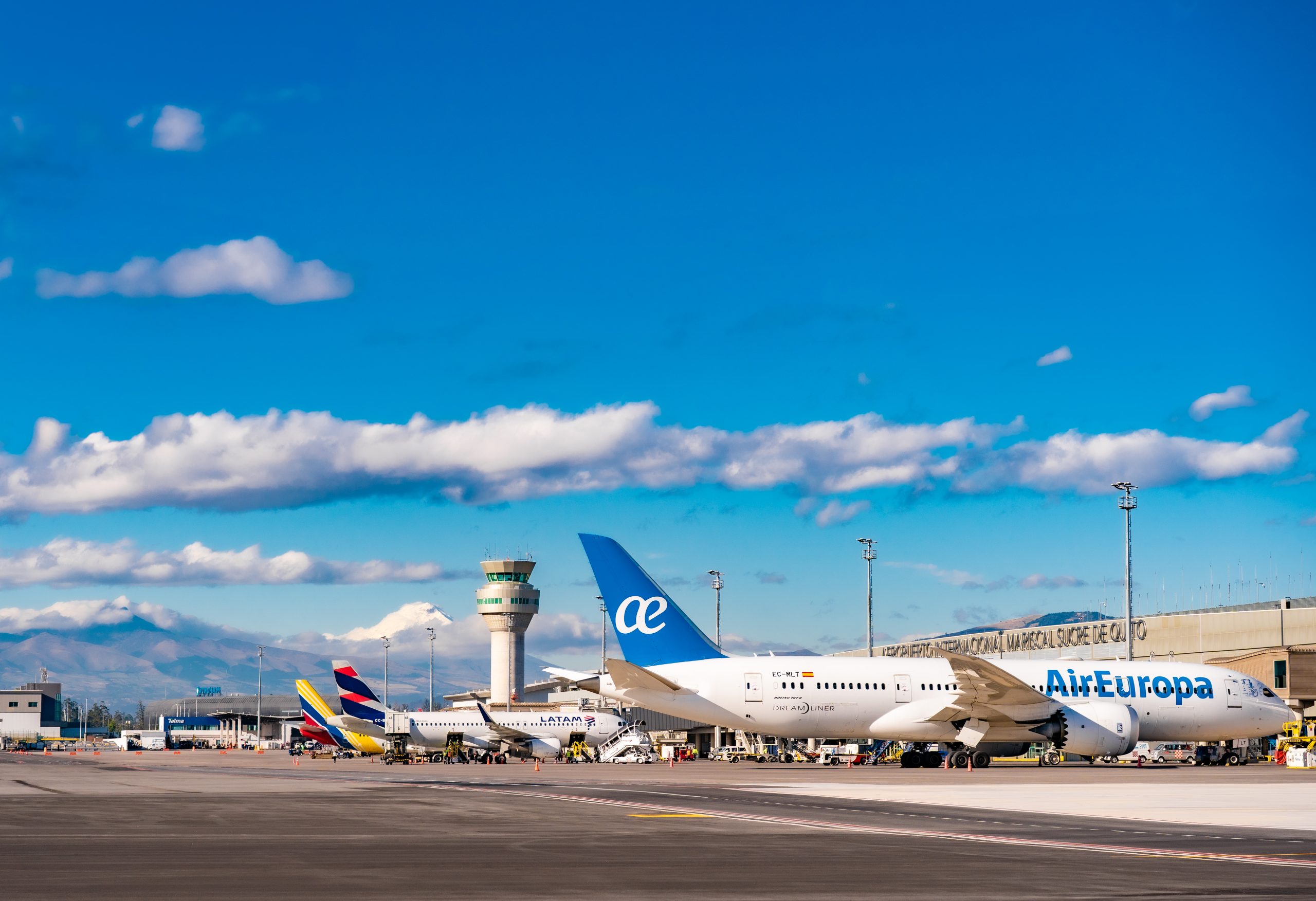
The year 2025 marked a turning point for Mariscal Sucre International Airport. Under the management of Corporación Quiport, the airport consolidated a key expansion and strengthened its operational, logistical, and connectivity performance.
Expansion and Capacity
With an investment of US$74.2 million, financed with Quiport’s own resources, the airport expansion became operational. The project, carried out by Ecuadorian workers, adds 17,647 m² to the passenger terminal and 35,000 m² to the apron, and incorporates larger areas for both international arrivals and departures, improvements to the baggage handling system, a reconfigured Customs area, new commercial spaces, 20 new airline check-in counters, and 12 self-service check-in kiosks. A pre-boarding lounge for 350 passengers; and the expansion of the international VIP lounge, which will be completed in 2026. These improvements increase the airport’s capacity from 5 to 7 million passengers annually.
Operational Efficiency
The implementation of new biometric gates in international departures streamlined immigration controls and enhanced the passenger experience, aligning operations with international standards. In the first phase of operation, the biometric gates can be used by Ecuadorian passengers over 18 years of age traveling to South American countries that do not require a visa.
Air Connectivity
During 2025, Quito Airport handled 5.4 million passengers, with 12 commercial airlines operating flights connecting the capital to 8 domestic and 14 international destinations. This performance solidifies the airport’s position as a strategic connection point for the country and the region. In this context, they highlighted the launch of direct Quito-Madrid flights by Air Europa and the announcement of the resumption of the Quito-Mexico City route by Aeroméxico—which will begin operations in March 2026—expanding connection options with Europe and North America. Additionally, there were increased frequencies to New York, Panama City, Bogotá, Lima, and Houston, increasing the number of seats available to these destinations.
The first four months of 2025 were marked by the uncertainty inherent in an electoral process, which influenced a reduction in passengers. However, starting in May, Quito’s airport registered a sustained increase in the number of travelers, allowing for a positive year-end, with a slight increase compared to 2024, a year in which 5.3 million passengers traveled.
Air Cargo
The logistics operation reaffirmed its regional leadership and maintained the growth trend recorded since 2021; Cargo volume grew from 364,000 metric tons in 2024* to 407,000 metric tons in 2025**, transported by 16 operating cargo airlines, consolidating Quito as a key driver of foreign trade, especially in flower exports, which account for 93% of the cargo exported from Quito Airport.
Experience and Recognition
Below are some of the key recognitions awarded by international organizations and specialized authorities, reflecting the operational performance, service quality, and environmental management of Mariscal Sucre International Airport during 2025.
- Quito Airport among the most punctual in the world, according to Cirium.
- Best Airport in Latin America and the Caribbean, in the Airport Service Quality (ASQ) program of the Airports Council International.
- Best Regional Airport in South America, in the Skytrax World Airport Awards.
- Fifth place in air cargo in Latin America and the Caribbean, according to ACI-LAC.
- Level 5 Passenger Experience Accreditation, renewed by the Airports Council International (ACI).
- “Blue Point” recognition, awarded by the Ministry of the Environment, for water management at Quito Airport.
- Award for coexistence between biodiversity and air operations, granted by ACI-LAC.
In summary, 2025 consolidated a larger, more modern, and more efficient airport, prepared to support the future growth of air transport, strengthen Ecuador’s logistics and connectivity, and enhance its contribution to tourism and the country’s economic development.
- Data corrected after receiving official figures from the General Directorate of Civil Aviation. The preliminary figure published on January 2, 2025, was 354,000 tons.
** Preliminary figures.